从世界第二(2017年第34周)到世界第一(2024年第24周),他奋战了近七年,国羽等待了八年(谌龙,2016年第22周)。
From world No. 2 (Week 34, 2017) to world No. 1 (Week 24, 2024), he fought for nearly seven years, and the Chinese national badminton team waited for eight (Chen Long, Week 22, 2016).
从世锦赛亚军(2018年南京)到世锦赛冠军(2025年巴黎),这个世界冠军的头衔,他努力了七年,国羽等待了十年(谌龙,2015年雅加达)。
From World Championships runner-up (Nanjing 2018) to World Championships gold medalist (Paris 2025), this world title took him seven years of effort, and the Chinese national badminton team waited for ten (Chen Long, Jakarta 2015).
2025 World Championships Final: Shi Yuqi defeats Kunlavut Vitidsarn 19-21, 21-10, 21-18 in a stunning comeback to claim his first world title.
从出道即巅峰、曾万众瞩目的亚青赛冠军(2014年台北)、世青赛亚军(2014年亚罗士打)和青奥会冠军(2014年南京),到从无到有、从一到多的多个团体世界冠军(2019年南宁苏迪曼杯、2021年万塔苏迪曼杯、2023年苏州苏迪曼杯、2025年厦门苏迪曼杯;2018年曼谷汤姆斯杯、2024年成都汤姆斯杯),再到国羽历史上的首个1000赛全满贯获得者(2018年全英公开赛;2024年印尼公开赛;2025年马来西亚公开赛;2025年全英公开赛;2025年中国公开赛)和两次世巡赛总决赛冠军得主(2018年广州、2024年杭州)——从天才少年,到团体战神,再到世界第一——无论从何角度,他似乎早已满身荣耀,却因为身为国羽一单而无个人世冠头衔饱受诟病,在一众前辈的辉煌历史里反复执迷。
From a prodigy who burst onto the scene at his peak—an Asian Junior Champion (Taipei 2014), World Junior runner-up (Alor Setar 2014), and Youth Olympic champion (Nanjing 2014)—to a cornerstone of multiple team world titles that grew from nothing to many (Sudirman Cup: Nanning 2019, Vantaa 2021, Suzhou 2023, Xiamen 2025; Thomas Cup: Bangkok 2018, Chengdu 2024), to the first-ever Super 1000 Grand Slam winner in Chinese national team history (All England Open 2018; Indonesia Open 2024; Malaysia Open 2025; All England Open 2025; China Open 2025) and a two-time BWF World Tour Finals champion (Guangzhou 2018, Hangzhou 2024)—from teenage prodigy, to team event talisman, to world No. 1—by any measure, he seemed long covered in glory. Yet, as the leading men’s singles player for China, he was relentlessly criticized for lacking an individual world title, lost in obsessive comparison against the dazzling legacies of his predecessors.
已不记得,从何时起,开始对石宇奇开始有比较深刻的印象。大概是从2018年曼谷汤杯作为第二单打以全胜的成绩助男团夺冠(还记得那时是在外婆家拿着平板看的回放),抑或是同年的年终总决赛以大比分2:0击败正式步入巅峰的新王桃田贤斗第一次获得生涯。我想,那时候大概已在心里把石宇奇和桃田贤斗这对双子星视为羽坛的新一代林李——此前夏煊泽、林丹、陈金和谌龙等一众前辈成绩斐然,近乎包揽了21世纪以来的所有世锦赛男单项目冠军,因而那时理所应当地认为男单这一项目就该被国羽统治——认为石宇奇必定未来可期,会是下一位站在世界羽坛顶峰的国羽领军人物。
I no longer remember when I first started to form a lasting impression of Shi Yuqi. Perhaps it was during the 2018 Thomas Cup in Bangkok, when he competed as the second singles player and helped the men’s team claim the title with an undefeated record (I still recall watching the replay on a tablet at my grandmother’s house). Or perhaps it was later that same year at the BWF World Tour Finals, when he defeated the newly crowned king Kento Momota—then officially entering his prime—in straight games to capture the first major title of his career.
I think, back then, I had already come to regard the duo of Shi Yuqi and Kento Momota as the new-generation Lin Dan and Lee Chong Wei of world badminton. After all, predecessors like Xia Xuanze, Lin Dan, Chen Jin, and Chen Long had achieved such remarkable success—nearly monopolizing every men’s singles title at the World Championships since the turn of the century—that I took it for granted that the men’s singles discipline would always be under the dominion of the Chinese national team. I believed Shi Yuqi’s future was boundless, and that he would surely be the next leading figure of Chinese badminton to stand atop the world.
但仍记得,接踵而至的每一次苦难将石宇奇不断击溃、反复磨砺着他。2018年南京世锦赛决赛被巅峰桃田贤斗两局直落、2019年印尼公开赛16进8对阵安东森的比赛过程中意外韧带断裂、2021年奥运会八强被巅峰安塞龙两局血洗、2021年汤姆斯杯对阵桃田贤斗赛点退赛后因在社交媒体口嗨被禁赛和退回省队、2023年全英赛和杭州亚运会决赛溃败师弟李诗沣、同年世锦赛八进四因体能不支憾负奈良冈功大、2024年以一号种子的身份在奥运会八强爆冷输给H2H占据极大优势(此前三连胜)的新科世锦赛冠军昆拉武特。我想,对于任何普通人来说,这些苦难的其中任一,就足以彻底消沉其意志、毁灭其信念;然而,在一次次经历中,石宇奇反而变得越发沉着冷静、越发宠辱不惊——特别是,当熬过了巴黎折戟的低谷后,肉眼可见地,无论面对何等困境,无论逆转的可能性多么微乎其微,他都用越发强大的意志品质去竭尽全力创造可能性,球不落地,永不放弃——他再也不是那个赛点退赛的轻狂少年了!
Yet I still remember, vividly, how each ensuing hardship struck Shi Yuqi down, grinding and tempering him time and again. The straight-game defeat to a peak Kento Momota in the 2018 Nanjing World Championships final; the freak ligament rupture mid-match against Anders Antonsen in the round of 16 at the 2019 Indonesia Open; the merciless drubbing by a peak Viktor Axelsen in the quarterfinals of the 2021 Olympics; the controversial retirement on match point against Momota at the 2021 Thomas Cup, followed by a suspension and demotion to the provincial team for reckless remarks on social media; the crushing losses to junior teammate Li Shifeng in the finals of the 2023 All England and Hangzhou Asian Games; the heartbreaking defeat to Kodai Naraoka in the World Championships quarterfinals that same year, his legs failing him when it mattered most; and the stunning upset in the quarterfinals of the 2024 Olympics, where, as the top seed, he fell to reigning world champion Kunlavut Vitidsarn—an opponent he had dominated head-to-head with three straight wins prior.
For any ordinary person, I imagine, just one of these trials would be enough to shatter the spirit and extinguish all belief. Yet through each ordeal, Shi Yuqi has emerged ever more composed, ever more unshaken by triumph or defeat. Most remarkably, after weathering the crushing low of his Paris disappointment, it has become plain to see: no matter the adversity he faces, no matter how faint the hope of a comeback, he now wields an ever-stronger force of will, straining every sinew to forge possibility from impossibility. The shuttle has not touched the floor—he will never give up. He is no longer the impetuous youth who retired on match point!
回望石宇奇世锦赛之旅的全程,每场都惊心动魄。签运极差,胜似被手写针对:国羽男单悉数汇聚于上半区,从64进32起,一路斩落巴黎奥运会殿军拉克什亚、主场作战的法国三剑客之一的小波波夫、正值壮年的国羽第三单打翁泓阳;在半决赛顶住绝对黑马、新科泛美州锦标赛男单冠军(此前,这一项目在连续数年内被东京奥运会殿军科登和加拿大好手杨灿轮流包揽),年仅20岁的赖浩俊的猛烈冲击后,与昆拉武特会师决赛,并以三局19:21-21:10-21:18的比分艰苦鏖战76分钟,逆转夺冠。
Looking back on Shi Yuqi’s entire journey through this World Championships, every single match was utterly heart-stopping. The draw was abysmal, as if scripted against him by hand: all of China’s men’s singles players were crowded into the top half of the bracket. From the round of 64 onward, he carved his way past Lakshya Sen, the Paris Olympic fourth-place finisher; past Christo Popov, one of the “Three Musketeers” of French badminton playing on home soil; and past Weng Hongyang, China’s third singles player, then in the prime of his career. In the semifinals, he withstood the ferocious onslaught of the tournament’s absolute dark horse, 20-year-old Lai Haojun—the newly crowned Pan American Championships men’s singles titlist (a title that, for years prior, had been traded exclusively between Tokyo Olympics fourth-place finisher Kevin Cordón and Canadian standout Brian Yang). After surviving that test, Shi advanced to the final to face Kunlavut Vitidsarn once more. There, in a grueling 76-minute battle that twisted and turned through three games—19-21, 21-10, 21-18—he came from behind to seize the title at last.
单论最后的决赛,第一局顺风边,石宇奇坚持不起球,曾一路领先至16:9和18:12,却在局歇后被状态逐渐回暖的昆拉武特疯狂抓反手后场使石宇奇连续受迫性失误被逆转。那时候,刚看过昆拉武特八进四和半决赛轻取乔纳坦[5]和安东森[2]的比赛的情况下,悲观地想,难道石宇奇这一路的艰难前行,就要止步于此了吗?所幸,此时的石宇奇非彼时同一片场地上,巴黎奥运会八进四的比赛中面对昆拉武特的那个他。在第二局逆风的情况下,石宇奇迅速调整自己,继续坚定不起球的战术,并充分借助顶风的优势反复推挑昆拉武特反手后场,以21:10的大比分进入决胜局。
Focusing solely on the final itself: in the first game, playing on the side with the drift, Shi Yuqi resolutely refused to lift the shuttle, sticking relentlessly to his flat game. He built commanding leads of 16-9 and 18-12, only to see a resurgent Kunlavut—finding his rhythm after the mid-game interval—relentlessly target Shi’s backhand rear court. The pressure forced a string of unforced errors from Shi, and the game slipped away in stunning reversal. At that moment, having just watched Kunlavut breeze past Jonatan Christie [5] in the quarterfinals and Anders Antonsen [2] in the semifinals, I couldn’t help but think pessimistically:
After such a grueling path to get here, is this really where it all ends for Shi Yuqi?
Fortunately, the Shi Yuqi standing on that court was no longer the same man who had faced Kunlavut on this very same stage in the quarterfinals of the Paris Olympics. In the second game, now playing against the drift, he adjusted swiftly. He maintained his unwavering refusal to lift the shuttle, doubling down on the tactic, and this time he exploited the advantage of hitting into the wind to full effect. Again and again, he pushed and lifted deep into Kunlavut’s backhand rear corner. The result was a dominant 21-10 scoreline, sending the match into a deciding third game.
来到决胜局,前半局是顺风,正如“麻辣鸭舌”解说席的鸭哥(东京奥运会混双冠军)和林贵埔(石宇奇同期的双子星,世青赛冠军,因伤退役)所说那样,只要前半局顺风边咬紧比分不要拉开太大差距,就有很大希望。前半局,处于劣势边的石宇奇开局就先因心态波动导致连续主动失误而连续失分,被打至3:6落后。然而,在我又悲观地认为昆拉武特要提速起势的情况下,石头再次快速调整、控制失误,竟在劣势边以11:9的优势逆转比分进入局歇。交换场地后,再一次处于逆风边,石宇奇延续第二局的战术和球路,连续得分至16:10,此后再遭昆拉武特燃命提速,将比分追至19:18(与第一局处于同一分数,之后便被翻盘)。所幸,在这又一个晦暗的关键时刻,石宇奇稳住了心态、控制失误,最终在昆拉武特推球出后场后将全场的比分最终定格在了21:18。
Heading into the deciding game, the first half was played on the side with the drift. Just as “Spicy Duck Tongue” commentators Yage (Tokyo Olympics mixed doubles champion) and Lin Guipu (Shi Yuqi’s contemporary “twin star,” World Junior champion whose career was cut short by injury) had pointed out, as long as he could keep the score tight and not let the gap widen too much while on the unfavorable side in the first half, there was plenty of hope.
Early in that first half, playing from the disadvantageous end, Shi Yuqi’s mindset wavered. A flurry of unforced attacking errors saw him fall behind 3-6. Yet, just as I was sinking back into pessimism—convinced that Kunlavut was about to step on the gas and seize all momentum—Shi steadied himself once more with remarkable speed. He reined in the errors, and against the odds, clawed his way from the disadvantageous side to an 11-9 lead at the mid-game interval.
After changing ends, now back on the side against the drift, Shi picked up exactly where he had left off in the second game. He stuck to the same tactics and shot patterns, rattling off point after point to surge ahead 16-10. Then came Kunlavut’s desperate, life-or-death acceleration—a furious rally that saw the Thai star close the gap all the way to 19-18, the exact same precarious scoreline that had preceded his stunning reversal in the first game. This was another dark, defining moment. But this time, thankfully, Shi Yuqi held his nerve. He controlled the errors. And when Kunlavut’s final push drifted just long over the back line, the score was frozen for all time at 21-18.
当最后一球落地后,石宇奇掩面痛哭,久久跪地。孙俊指导与乔斌指导在互相激动地拥抱后,还没等昆拉武特挑战失败,便冲上来与石宇奇抱在一起。此刻,是如父子一般的师徒二人一路艰苦努力的圆满时刻,也是二人时隔26年分别获得世锦赛冠军的传承。从青奥会冠军,到世界第二和世锦赛亚军,再到世界第一和世锦赛冠军、顶级公开赛全满贯,这一路的不易只有他们自己知道!永远会为孙爸和石头赛后的拥抱而感动!
When the final shuttle hit the floor, Shi Yuqi buried his face in his hands and wept, kneeling on the court for a long, long moment. Coaches Sun Jun and Qiao Bin, having just embraced each other in wild excitement, didn’t even wait for Kunlavut’s challenge to be ruled unsuccessful—they rushed onto the court and wrapped Shi Yuqi in their arms.
This moment was the culmination of a grueling journey shared by a master and his disciple, a bond as close as father and son. It was also a moment of profound legacy: twenty-six years apart, the two had each claimed a World Championships title of their own. From Youth Olympic champion, to world No. 2 and World Championships runner-up, to world No. 1, world champion, and a career Grand Slam of elite Open titles—only they truly know the hardships endured along this road. The embrace between “Papa Sun” and Shi after the match will never fail to move me!
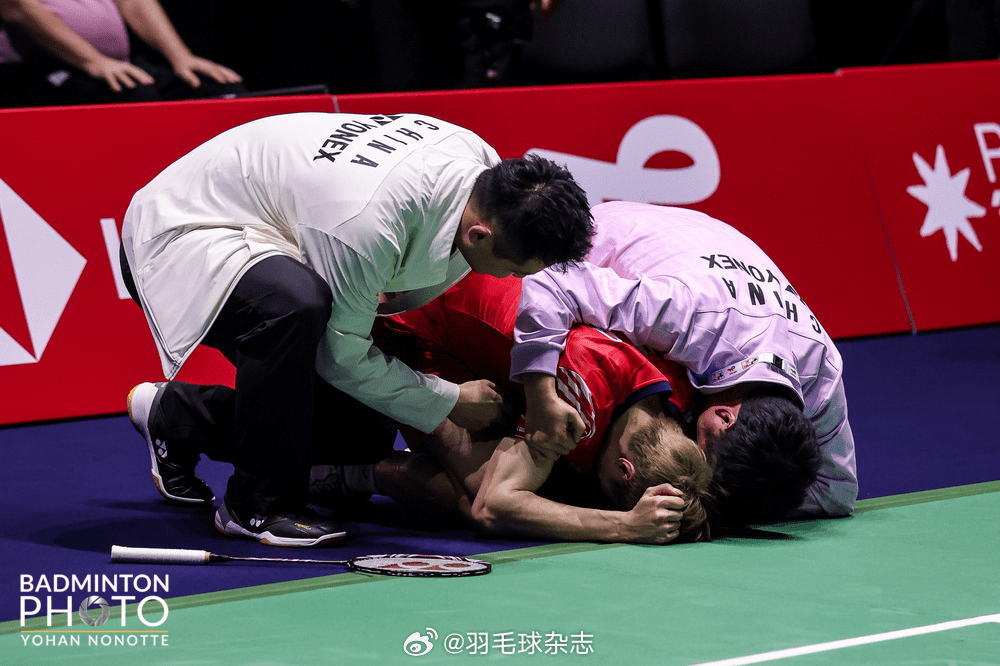
As Kunlavut’s final shot drifted out of bounds, Shi Yuqi was crowned champion, and together with coaches Sun Jun and Qiao Bin, they embraced in a scene reminiscent of the “Oath of the Peach Garden” — a brotherhood forged in triumph.
这一刻,我在屏幕前也感动落泪。曾几何时,我的偶像在巴黎折戟,将头发染得灰白;在日本公开赛负于拉尼尔后,言语间已是难掩内心的满目疮痍;在中国公开赛0-2溃败金庭被淘汰后,更是直言已完全麻木、失去了职业生涯的方向。后来,历经一段时间的调整,当年终总决赛小组赛再次遭遇让他巴黎梦碎的昆拉武特时,即使面对6:14这样近乎不可能逆转的比分,石宇奇依然顶住压力,以顽强的意志品质在拉掉中寻找机会,一分一分咬住,最终以25:23的比分逆转——当解说激动地高喊“顺境不骄不躁,逆境浴火重生”时,感动之余,忽觉他似乎终于放下了内心的包袱,以平静的心态和坚定的信念在自己职业生涯的中后期重新出发。再后来,在今年的次次大赛里,即使每一场比赛都看似暗藏杀机,但石宇奇却总能一次次化险为夷,顶住各路好手的冲击(传奇耐冲王名不虚传!),以无比惊险的比分最终夺冠(2025已获全英、马公、日公、中公)。
In that moment, I too was moved to tears in front of the screen. How many times had my idol been battered and bruised? After crashing out in Paris, he dyed his hair a somber gray; after falling to Lanier at the Japan Open, his words could no longer conceal the devastation within; and after being swept 0-2 by Ginting and eliminated at the China Open, he confessed outright that he had gone completely numb, that he had lost all sense of direction in his career.
Then, after a period of recalibration, he faced Kunlavut once more in the group stage of the year-end World Tour Finals—the very man who had shattered his Olympic dream in Paris. Facing a seemingly insurmountable deficit of 6:14, a scoreline from which reversal was all but impossible, Shi Yuqi held firm under the crushing pressure. With unyielding will, he probed for openings in the rallies, clawing back point by relentless point, until he had snatched the game away at 25-23. When the commentator cried out in excitement, “In triumph, never arrogant or impulsive; in adversity, reborn from the flames,” I was stirred not just by emotion, but by a sudden realization: it seemed he had finally set down the burden in his heart. With a tranquil mind and steadfast conviction, he was setting out anew in the middle-to-late stages of his career.
Since then, in tournament after tournament this year, even when every match seemed to conceal hidden daggers, Shi Yuqi has time and again found a way to defuse the danger. He has withstood the onslaught of challenger after challenger (the legend of the “King of Withstanding Onslaughts” is well-earned!), and has seized title after title—All England, Malaysia Open, Japan Open, China Open—with breathtakingly narrow scorelines, all in the year 2025 alone.
2024 Indonesia Open Final: Shi Yuqi defeats Anders Antonsen 21-9, 12-21, 14-21 (Note: The scoreline appears to have a typo in the original text — it should likely read 21-9, 12-21, 21-14). This marks Shi Yuqi’s first Indonesia Open title, and the first for the Chinese national team in 36 years, since Xiong Guobao claimed the crown in 1989.
2025 Malaysia Open Final: Shi Yuqi defeats Anders Antonsen 21-8, 21-15 to claim his first Malaysia Open title.
2025 All England Open Final: Shi Yuqi defeats Li Xuanhao 21-17, 21-19 to capture his second All England title.
2025 China Open Final: Shi Yuqi defeats Wang Zhengxing 14-21, 21-14, 21-15 in a comeback victory to claim his first China Open title. With this win, he becomes the first men’s singles player in Chinese national team history to complete a career Super 1000 Grand Slam.
2024 BWF World Tour Finals, Group Stage Round 2: Shi Yuqi overcomes a 6-14 deficit in the deciding game to defeat Kunlavut Vitidsarn, securing his spot in the knockout stage.
2024 BWF World Tour Finals Final: Shi Yuqi defeats Anders Antonsen 21-18, 21-14 to capture his second World Tour Finals title.
其实,甚至世锦赛前,我都一直认为石宇奇的一次次惊险逆转很大程度上还是有幸运的成分。然而,当一场不落地看完石宇奇世锦赛的每一场比赛,看到一次次他顶住冲击后的冷静逆转,才惊觉致胜的真正关键在于其真正强大的意志品质——64进32、32进16面临拉克什亚和朱利安时,石宇奇状态极佳,大比分取胜;而后直至总决赛,场场打满三局,回回惊险刺激——16进8,面对日公次局搏杀至28:26才在毫厘之间艰难取胜的小波波夫,当第一局20:22落败时;8进4,面对正值壮年的国羽队友翁弘阳(三单),第二局7:21溃败,让人浮想难道印尼公开赛半决赛被安东森逆转的剧本要重演时;面对世界排名仅50,却接连斩落陆光祖、全奕陈和骆建佑的绝对黑马赖浩俊,当第一局13:21溃败、第二局面临18:20的绝境(那时已经不敢看比赛,只能不断刷新中羽在线的比分),真正命悬一线时——每一次我都无比难受地想,这一路辛苦至此,难道要就此止步的时候,石宇奇却总能冷静地处理局面,一次次逆转——这真的让人不由得想到总决赛奇迹逆转昆拉武特的那一分分,以及全英赛夺冠后采访时的那句“问题不大,我们再来”!
In truth, even right up until the World Championships, I had always harbored the thought that Shi Yuqi’s string of narrow escapes owed a significant debt to sheer luck. Yet, after watching every single one of his matches at the World Championships from start to finish, witnessing time and again how he withstood the onslaught and calmly turned the tide, it dawned on me with startling clarity: the true key to his victories lies in an extraordinarily formidable force of will.
In the round of 64 and round of 32 against Lakshya Sen and Julien Carraggi, Shi was in sublime form, winning by commanding margins. But from then on, all the way to the final, every match went the full three games, each one a heart-stopping thriller.
In the round of 16, facing Christo Popov—the same opponent he had barely edged out 28-26 in a second-game dogfight at the Japan Open—Shi dropped the first game 20-22. In the quarterfinals, facing his compatriot Weng Hongyang, then in his prime as China’s third singles player, Shi was routed 7-21 in the second game, conjuring nightmarish flashbacks of his semifinal collapse against Anders Antonsen at the Indonesia Open. And in the semis, up against the tournament’s absolute dark horse, the world No. 50 Lai Haojun—who had already slayed Lu Guangzu, Jeon Hyeok-jin, and Loh Kean Yew in succession—Shi crumbled 13-21 in the first game, then stared into the abyss at 18-20 in the second, his tournament life hanging by the thinnest of threads. (By that point, I couldn’t even bear to watch; I could only refresh the live score on the badminton forum, over and over.)
Every single time, a sickening feeling washed over me: After such a grueling journey to get here, is this truly where it ends? And yet, every single time, Shi Yuqi managed the situation with preternatural calm, reversing his fortunes again and again. It was impossible not to think back to that miraculous point-by-point comeback against Kunlavut at the World Tour Finals, and to those words he uttered in an interview after winning the All England title: “No big problem. Let’s just run it back.”
2025 World Championships, Round of 32: Shi Yuqi comes from behind to defeat Christo Popov 20-22, 21-13, 21-18.
2025 World Championships, Semifinal: Shi Yuqi stages a remarkable comeback to defeat Lai Haojun 13-21, 22-20, 21-16, advancing to the final.
没有任何人能与重伤后的他、与奥运接连梦碎的他真正共情,也没有人能完全感同身受于一次次在顶峰坠落、跌入谷底时的他内心深处的痛楚。作为国羽男单这个拥有无数优秀前辈(九位世锦赛男单冠军和三位奥运会男单冠军)、底蕴深厚的队伍的一员,尤其自2018年彻底从男单历史第一人林丹和历史第三人谌龙手中接过第一单打的头衔和责任后,网络上总是充斥着各种诟病他无个人世冠荣耀的舆论,即使再是团体赛的定海神针,也不抵任何波动都会遭到社交平台上各路键盘侠猛烈的抨击。
No one can truly empathize with the man he became after that devastating injury, or with the man who saw his Olympic dreams shattered time and again. No one can fully fathom the anguish deep within his heart as he plunged from the summit to the abyss, over and over.
As a member of China’s men’s singles squad—a team steeped in profound legacy, boasting a pantheon of illustrious predecessors (nine World Champions and three Olympic Champions in men’s singles)—and especially since 2018, when he formally assumed the mantle and responsibility of first singles from Lin Dan, the greatest of all time, and Chen Long, the third-greatest in history, the internet has been ceaselessly awash with criticism harping on his lack of an individual world title. No matter how unshakable a pillar he was in team events, any flicker of inconsistency would invite a ferocious barrage of attacks from keyboard warriors across social media.
因此,无论从任何意义上讲,这个来之不易的世锦赛冠军都对他无比重要!在我心中,此后,作为青奥会冠军、世锦赛冠军、1000赛全满贯、4次苏杯和2次汤杯冠军、2次总决赛冠军、56周的世界第一排名,以及截至世锦赛时全年90.9%的胜率,已经足以让这位一路坎坷的国羽扛旗人位列超一流之列!更重要的是,往后,他不需要再证明自己,而是可以更好地放下执念,在球场上追寻自己人生的任何一缕意义!
And so, by every conceivable measure, this hard-earned World Championships title means everything to him.
In my heart, from this moment forward, his resume stands as testament enough: Youth Olympic champion, World Champion, Super 1000 Grand Slam winner, four-time Sudirman Cup and two-time Thomas Cup champion, two-time World Tour Finals champion, fifty-six weeks as world No. 1, and a staggering 90.9% win rate for the year up to the World Championships. All of it—every accolade, every scar—is more than sufficient to enshrine this battle-worn standard-bearer of Chinese badminton among the ranks of the all-time greats.
More importantly, he no longer needs to prove anything to anyone. From here on, he can set down his obsessions, and step onto the court to pursue whatever sliver of meaning he wishes to find in the game of his life.

After claiming the title, Shi Yuqi poses for a photograph with Coach Qiao Bin (far left), Coach Sun Jun (second from left), and Vice President Xia Xuanze (far right).
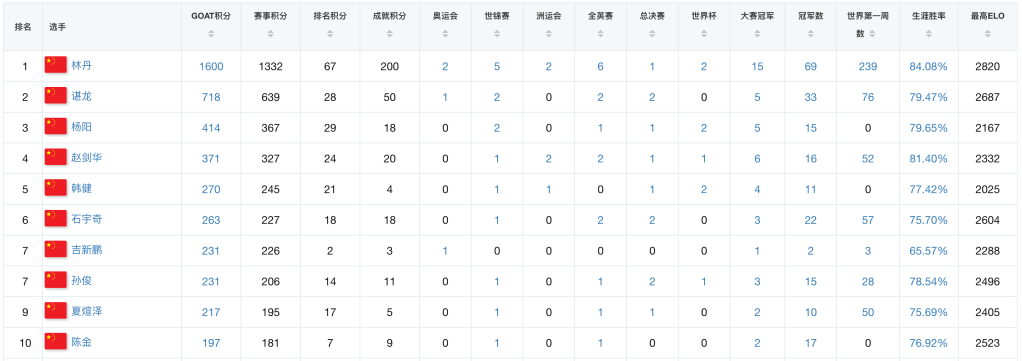
With the tournament ranking points from his World Championships title (+100), Shi Yuqi ascends to sixth place in the Chinese national team’s all-time standings, surpassing his mentor Coach Sun Jun, China’s first Olympic men’s singles champion Ji Xinpeng, Vice President Xia Xuanze, and “Boss Jin” (Chen Jin).

Following his World Championships triumph, Shi Yuqi remains firmly entrenched as world No. 1, with his ranking points surpassing the 110,000 mark for the very first time.
再次祝贺我的偶像石宇奇夺冠,收获生涯的第一个单项世界冠军头衔!感谢他在世锦赛期间奉献了一场场精彩的比赛,在无数精彩(甚至惊险)的回合间,真正展现着名副其实的世界第一和国羽一单的实力和魄力!此外,更要感谢石宇奇一路的坚持、感谢他一次次面对冲击时的永不言弃的拼搏精神!坚持长期主义者的一场里程碑式的胜利总是让人无比动容、给人以力量!往后,我也要学习偶像的意志品质,“顺境不骄不躁,逆境浴火重生”,无论遇到什么困境,都要竭尽全力、咬牙顶住!
Once again, my heartfelt congratulations to my idol Shi Yuqi on capturing his first individual world title! Thank you for delivering one spectacular match after another throughout these World Championships, and for showcasing, across countless breathtaking (and at times, hair-raising) rallies, the true strength and mettle befitting a bona fide world No. 1 and the leading man of Chinese badminton.
Beyond that, I am even more grateful for Shi Yuqi’s unwavering perseverance along this journey, and for his indomitable, never-say-die fighting spirit every time he has faced an onslaught. A landmark victory for a steadfast long-termist is always profoundly moving, and it imparts real strength to others.
From this day forward, I too will strive to emulate my idol’s force of will: “In triumph, never arrogant or impulsive; in adversity, reborn from the flames.” No matter what hardships I encounter, I will give everything I have, grit my teeth, and hold the line!
最后,行文至此,不由得想到巴黎折戟休息一段时间后,石宇奇微博发的翻唱自杨丞琳的《像是一颗星星》(原视频的内容更丰富,但可惜无法上传)——
Finally, as I write to this point, my thoughts inevitably drift back to that period after the Paris disappointment. Following a stretch of rest and recuperation, Shi Yuqi posted a video on Weibo of himself covering Rainie Yang’s song “Like a Star”. (The original video contained even richer material, but sadly, it cannot be uploaded here.)
附1:石宇奇2023-2025的比赛成绩概要
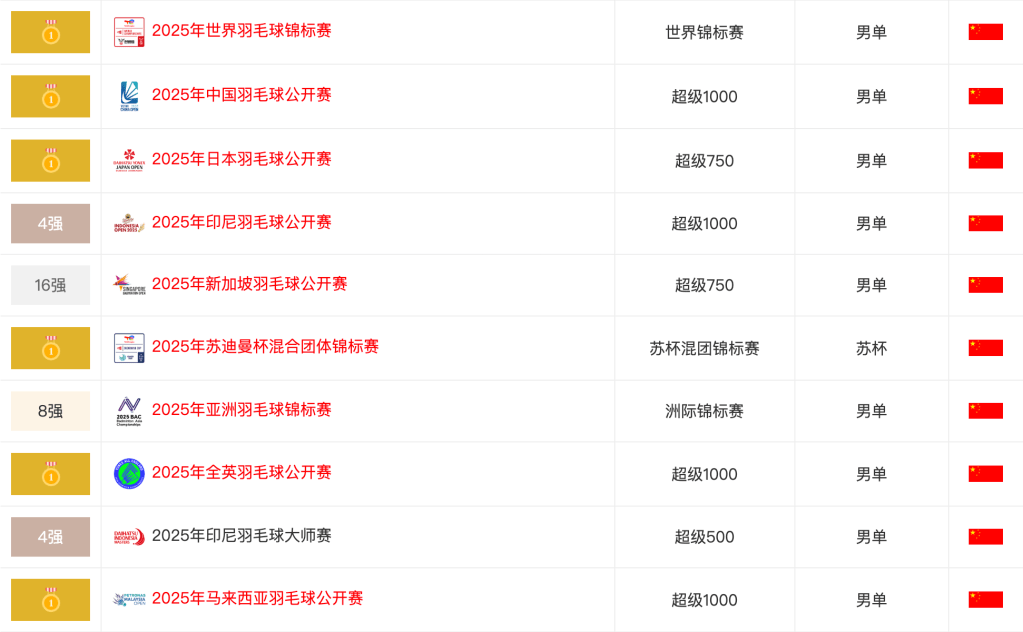
In the first half of 2025, Shi Yuqi has delivered a string of stellar results on the BWF World Tour. He reclaimed the All England Open title after a seven-year gap and, in doing so, completed a career Grand Slam of Super 1000 events. Among the tour’s premier tournaments, only the China Masters remains the one title he has yet to capture.

In 2024, Shi Yuqi topped the prize money earnings among all badminton disciplines on the BWF World Tour, and he recaptured the World Tour Finals title after a six-year hiatus. Yet, in a stunning upset at the Paris Olympics, he fell to Kunlavut Vitidsarn in the quarterfinals, his Olympic dream once again cut cruelly short.
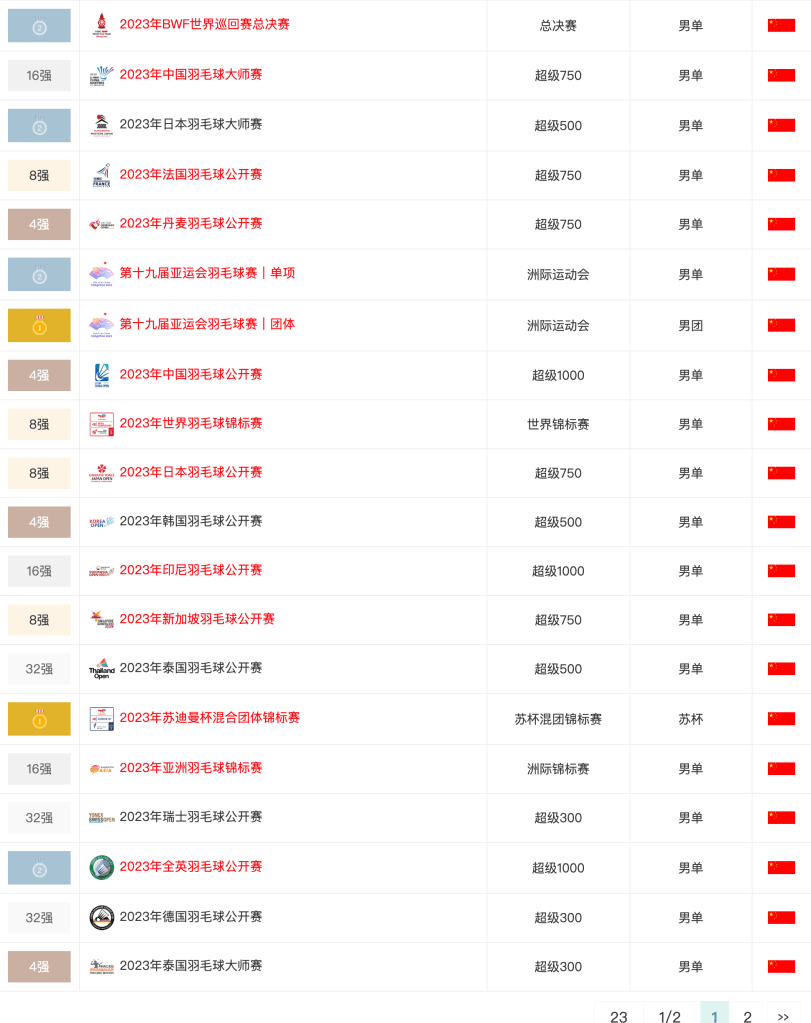
In 2023, returning from his suspension, Shi Yuqi worked tirelessly to recapture his form. Though he suffered agonizing final losses to Li Shifeng at both the All England Open and the Asian Games, and fell short against Viktor Axelsen in the finals of the Japan Open and the World Tour Finals, he delivered a superb performance in China’s triumphant Sudirman Cup campaign. To the naked eye, his overall condition was palpably, steadily on the mend.
附2:巴黎折戟后发的朋友圈
从2018年初登世界第二,到2024年成就世界第一,石宇奇用了六年,国羽男单等待了八年。作为一号种子,拿着赛会五个单项最好的签表之一,却因为未适应比赛节奏等原因,淘汰赛次轮两局溃败于新科世锦赛冠军昆拉武特,结束了巴黎的征途。我想,也许石宇奇是国羽有史以来成绩最平淡的一单了吧。
从纸面实力上看,这届奥运会国羽众人似乎有着甚至08年北京甚至12年伦敦时的厚度,但事实上男单一单石宇奇和二单李诗沣各自以一个比一个难以置信的比分溃败于昆拉武特和骆建佑。说来讽刺,这两位世锦赛冠军一度有着“最水”世界冠军的风评,却干净利落地击败了我们的一单二单。本期待两人分别打穿上下半场,会师决赛,结果确实如此令人难以置信、比赛看得让人血压飙升。
这届奥运会,男单石宇奇和混双郑思维是我最喜爱和关注的选手,他们分别是我单双打上的偶像。石宇奇千变的手法、郑思维无解的重杀是他们身上最具魅力和特色之所在,却是在刚欣赏完雅思打爆金银夺冠后目瞪口呆地看完昆拉武特各种手法停顿和简洁的进攻让石宇奇毫无招架之力…痛心,就像看到石宇奇亚锦赛输给乔纳坦,局歇时和孙俊指导说自己跟不上他的速度那般痛心——乔纳坦在小组赛输给拉克什亚,奈良冈工大也输给周天成时,以为苦主全部被解决了,只剩下决赛面对安赛龙的冲击时,却不想败给了最近全是干净利落两局拿下、三连胜的昆,好痛心。
但可能生活本就是这样充满着遗憾,不确定性也正是体育赛事的魅力。在小组赛和上一轮淘汰赛幸灾乐祸地看着乔纳坦、金庭、普兰诺依们的爆冷时,从未想到爆冷也将出现在石宇奇和李诗沣的身上。但可惜的是,奥运对于已经29岁的石宇奇来说已经大概率不会再有下一次了,无论再是苏杯战神抑或是汤杯战神,没有个人世界冠军,并且连续两届奥运会倒在八强上的中国队男子第一单打,始终会让人意难平。
From his debut at world No. 2 in early 2018 to finally reaching world No. 1 in 2024, it took Shi Yuqi six years—and the Chinese men’s singles program an eight-year wait. As the top seed, holding one of the best draws among all five disciplines for the national team, he was nevertheless routed in straight games in the second knockout round by newly crowned world champion Kunlavut Vitidsarn, his Paris campaign cut short by an apparent failure to find his competitive rhythm. I cannot help but think: perhaps Shi Yuqi is the least accomplished first singles player in the history of Chinese badminton.
On paper, this Olympic squad appeared to possess a depth rivaling even the legendary 2008 Beijing and 2012 London teams. Yet in reality, first singles Shi Yuqi and second singles Li Shifeng each succumbed to increasingly unfathomable defeats against Kunlavut and Loh Kean Yew respectively. There is a bitter irony in the fact that both of these world champions were once derided as the “weakest” ever to hold the title, only to dispatch our top two singles players with clinical efficiency. We had envisioned the two Chinese aces carving through opposite halves of the draw to set up an all-China final; instead, the outcome defied belief and sent our blood pressure soaring.
At this Olympics, men’s singles player Shi Yuqi and mixed doubles star Zheng Siwei were the athletes I cherished and followed most closely—my idols in singles and doubles respectively. Shi’s endlessly inventive touch and Zheng’s devastating, unanswerable smash constitute the very essence of their charm and brilliance. And yet, barely moments after basking in the glory of Zheng/Huang dismantling Kim/Jeong to claim gold, I watched in stunned disbelief as Kunlavut’s array of deceptive holds and crisp, economical attacks left Shi utterly defenseless. The ache was visceral—the same ache I felt watching Shi lose to Jonatan Christie at the Asian Championships, when he confessed to Coach Sun Jun during the interval that he simply could not keep up with Jonatan’s pace. When Jonatan crashed out to Lakshya Sen in the group stage, and Kodai Naraoka fell to Chou Tien-chen, I thought all of Shi’s nemeses had been cleared from his path, leaving only a final showdown against Viktor Axelsen to navigate. Never did I imagine he would fall to Kunlavut—an opponent he had recently beaten three times in a row, all in straight games, with apparent ease. The pain is immense.
But perhaps life is simply defined by such regrets, and uncertainty is the very essence of sport’s allure. As I watched with schadenfreude the stunning early exits of Jonatan Christie, Anthony Ginting, and H.S. Prannoy in the group stage and previous round, it never once crossed my mind that the same fate would befall Shi Yuqi and Li Shifeng. Regrettably, for Shi, now 29, there will almost certainly be no next Olympics. No matter how many times he proves himself a titan in the Sudirman Cup or an anchor in the Thomas Cup, China’s premier men’s singles player will forever be haunted by the absence of an individual world title and the cruel symmetry of back-to-back Olympic quarterfinal exits. That is a reality that will never sit right.
 惊起世相
惊起世相 